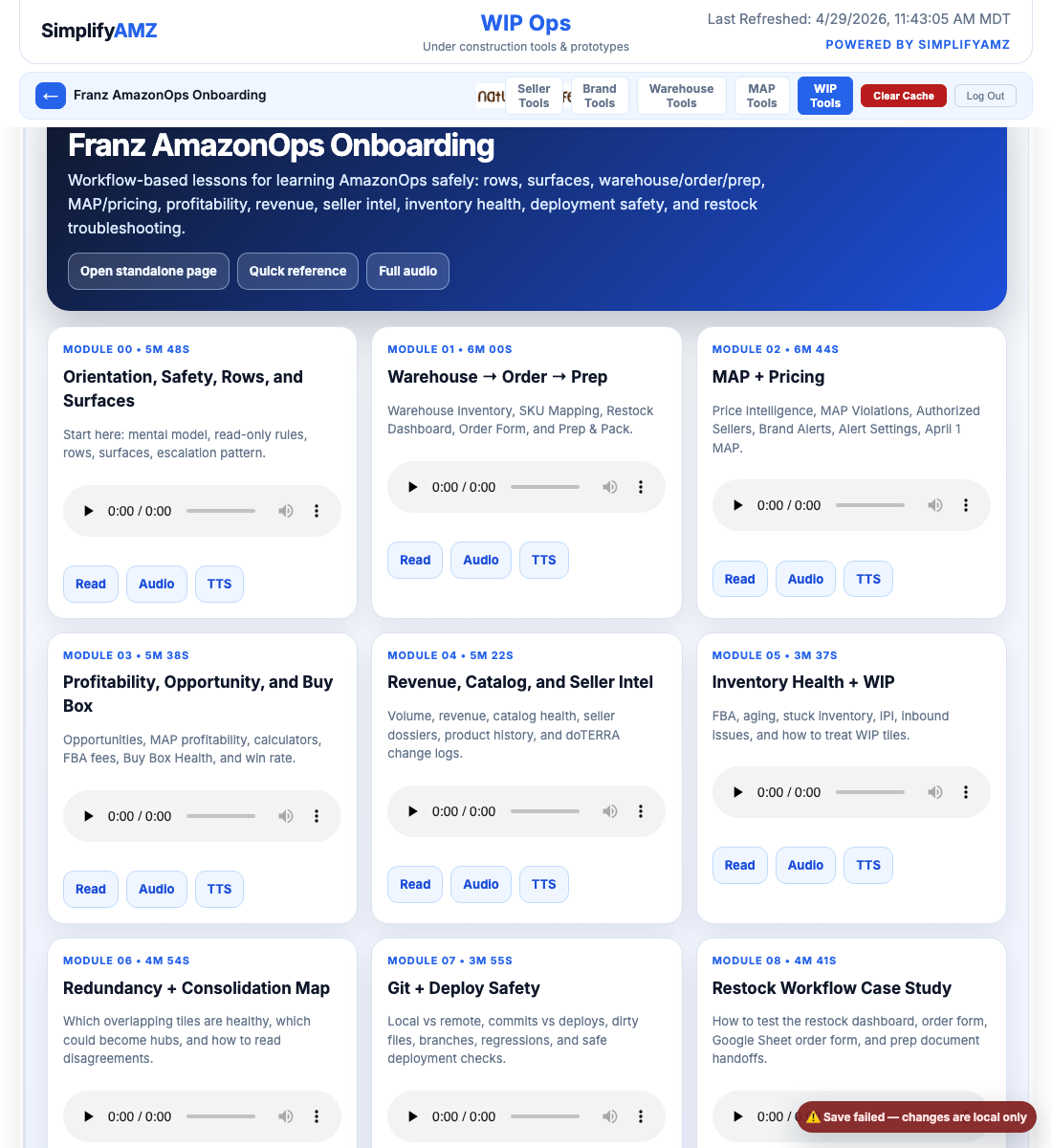
Profitability, Opportunity, and Buy Box
This layer prevents restocking or chasing products that look active but do not make business sense.
Business questions this lesson answers
- Is this product worth pursuing?
- Can we make money at MAP?
- Can we win the offer?
- Is an opportunity real or a data artifact?
Teaching rule
Franz should explain the purpose, the origin problem, every important part inside the tile group, and the action/escalation rule before moving on.
Pass 2 elaboration overlay
Why this exists
This layer prevents restocking or chasing products that look active but do not make business sense.
How this connects to restock and operations
This tile group either creates the restock decision, validates whether the decision is safe, or explains business context that can override the math. Franz should always connect the tile back to a real decision: monitor, investigate, reorder, block, or escalate.
What to listen for in the Pass 1 audio
The original Pass 1 lesson contains the dense operating details. In this upgraded Pass 2 version, Franz should listen once for orientation, then read the full source lesson below and mark any field or phrase he cannot explain.
Full Pass 1 lesson content — preserved and expanded
Module 03 — Profitability, Opportunity, and Buy Box Workflow
This workflow answers: is the product worth pursuing, can we make money, and can we win the offer?
1. Opportunities
Purpose: identifies authorized seller gaps and out-of-stock listings.
Current status: useful strategic tile. Inspected data showed 75 opportunities: 15 missing from our store and 60 currently listed out of stock.
Main sources: authorized seller coverage, store activity, profitability, sales estimates, and availability signals.
Relationship: connects stock, catalog coverage, and revenue potential. It often points back to Restock, SKU Mapping, or profitability.
Escalate when a suggested opportunity appears unmapped, unprofitable, restricted, or dangerous-goods complicated.
Ask Fergus: “Is this a real opportunity or just a missing mapping or availability artifact?”
2. MAP Profitability
Purpose: shows gross ROI by MAP price and helps decide whether a MAP-compliant price still makes money.
Current status: active business-planning tile, not a live pricing control.
Main sources: product fees, purchase cost, MAP reference prices, and profitability models.
Relationship: pairs naturally with Sell Price Calculator, WA vs Wholesale Profitability, and April 1 MAP Changes.
Escalate when a product is MAP-compliant but margin looks too thin, or a proposed sell price breaks margin logic.
Ask Fergus: “Are we checking gross ROI, net margin, MAP floor, or account-type profitability?”
3. WA vs Wholesale Profitability
Purpose: compares WA/LRP economics versus flat wholesale economics.
Use it when account type, purchase channel, PV, or discount logic affects whether a product is worthwhile.
Escalate when the profitability answer changes depending on account model.
Ask Fergus: “Which account model should control this decision?”
4. Sell Price Calculator
Purpose: quick what-if testing for a proposed sell price against profitability and MAP assumptions.
Use it for analysis only. It does not mean we should change Amazon pricing.
Escalate before treating a calculator result as an approved price action.
Ask Fergus: “Is this a pricing thought experiment or an approved pricing decision?”
5. 2025 Margins Summary
Purpose: historical gross and net margin view by ASIN.
Use it to understand what actually happened historically, not necessarily what will happen now.
Escalate when current profitability differs sharply from 2025 margin history.
Ask Fergus: “Did fees, MAP, purchase cost, or sales mix change since this history?”
6. Preferred Member Logic and Professional Account Logic
Purpose: rebuilt spreadsheet logic for purchase-to-profit and account-level calculations.
Use these when profitability depends on doTERRA account assumptions, PV, bonus, unilevel, or related spreadsheet logic.
Escalate when two profitability tiles disagree because they use different account assumptions.
Ask Fergus: “Is this Preferred Member logic, Professional Account logic, or flat wholesale logic?”
7. FBA Fees / Product Fees
Purpose: fee estimates and fee-related analysis.
Use it as an input tile. Fees affect every profitability calculation.
Escalate when a fee looks stale or materially changes margin.
Ask Fergus: “Is this current fee estimate, historical fee, or a cached fee input?”
8. Buy Box Health
Purpose: tracks buy box suppression, buy box damage, and BSR-related risk.
Current status: active analytical tile. Inspected local data showed 72 fully suppressed, 38 MAP-breaker, and 204 healthy ASINs in that snapshot.
Main sources: buy box suppression data, competitive pricing, BSR/history, and pricing state.
Relationship: overlaps with Competitive Pricing / Buy Box and Buy Box Win Rate, but focuses on health and suppression, not just current win/loss.
Escalate when an ASIN has stock and reasonable price but appears suppressed or losing visibility.
Ask Fergus: “Is this a suppression problem, a MAP-breaker problem, or a current buy-box competition problem?”
9. Buy Box Win Rate and Competitive Pricing / Buy Box
Purpose: shows whether The Natural Life is currently winning the buy box and how pricing compares.
Current status: active seller-ops view. It is narrower than Buy Box Health and more immediately tactical.
Main sources: competitive pricing current data, item offers, own seller ID, and buy box winner/featured offer signals.
Relationship: compare with Price Intelligence for B2B/business context and Buy Box Health for suppression context.
Escalate when our price is close but we are not winning, or another tile says we should be healthy.
Ask Fergus: “Is this a consumer buy box issue, a business featured-offer issue, or a suppression issue?”
Workflow drill
Pick one opportunity ASIN. Ask:
- Is there demand?
- Do we have stock or need restock?
- Does SKU Mapping understand it?
- Is it profitable at MAP?
- Are fees current?
- Can we win the buy box?
- Is there a MAP or seller-intel problem?
A product can be high revenue but low margin. It can be high margin but out of stock. It can have stock and margin but no buy box. Do not treat opportunity as approval.
End of module 03.
Original narration transcript
Screenshot references used in this curriculum
franz education tile
franz module 09 visible
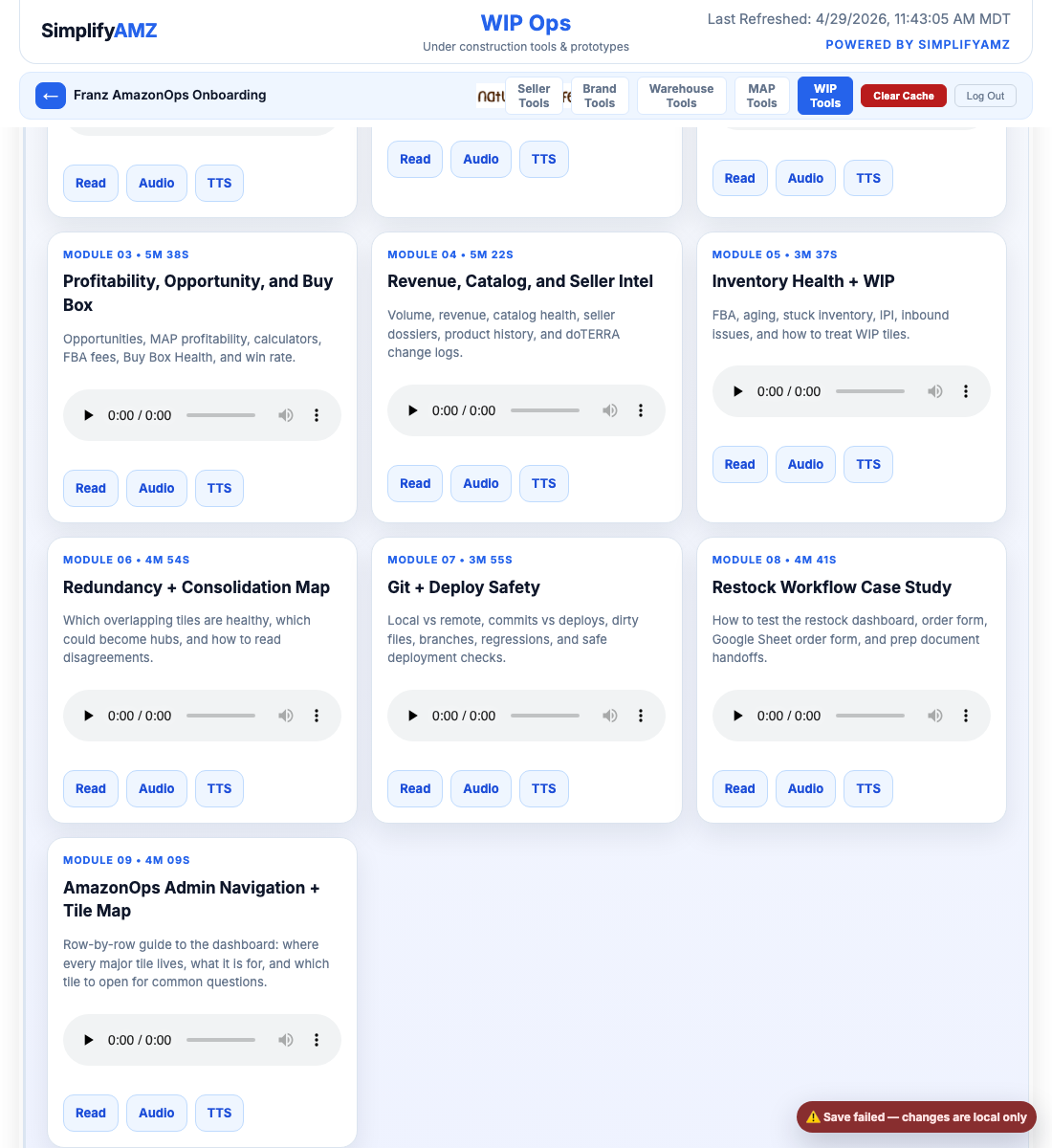
franz onboarding open
franz start here first
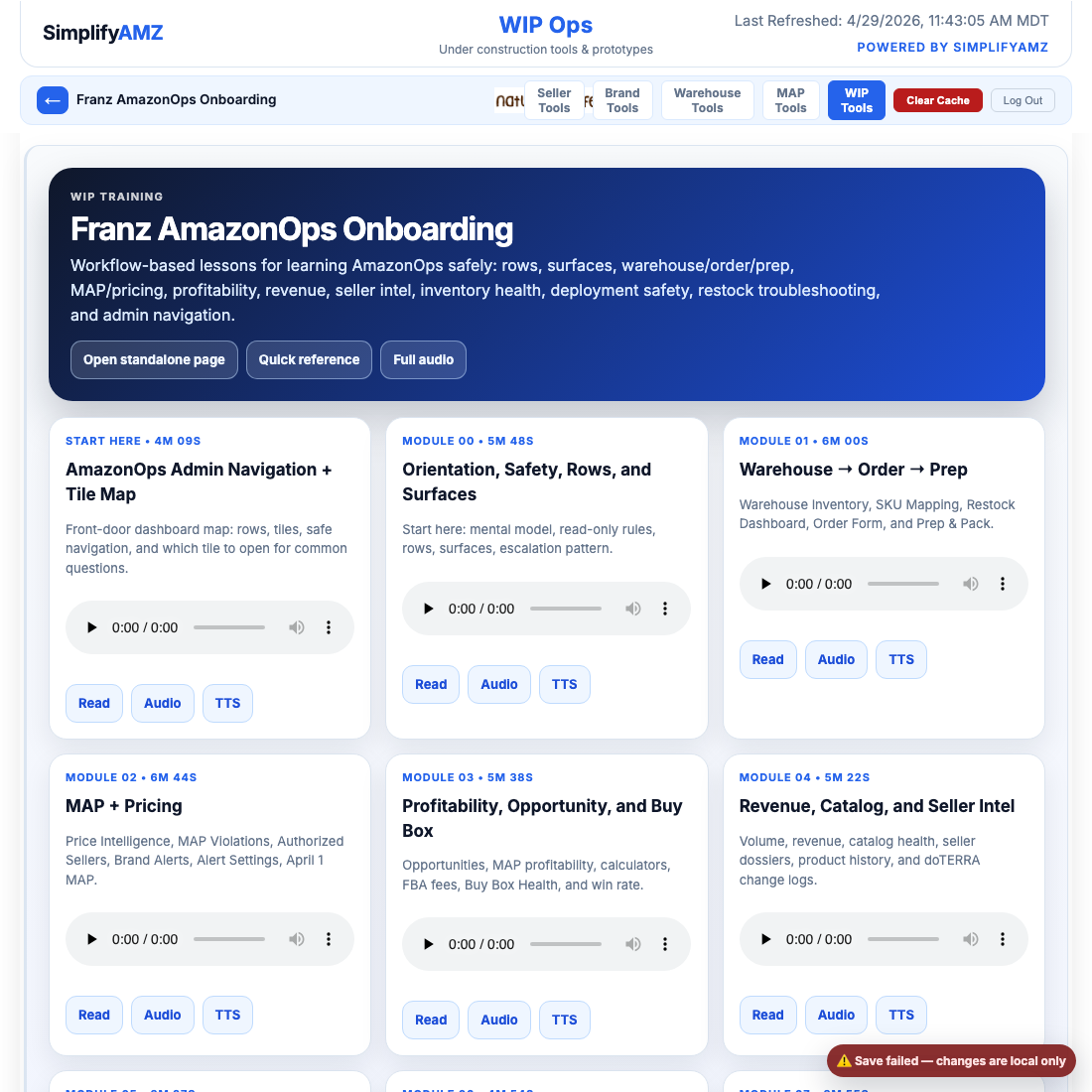
franz training section