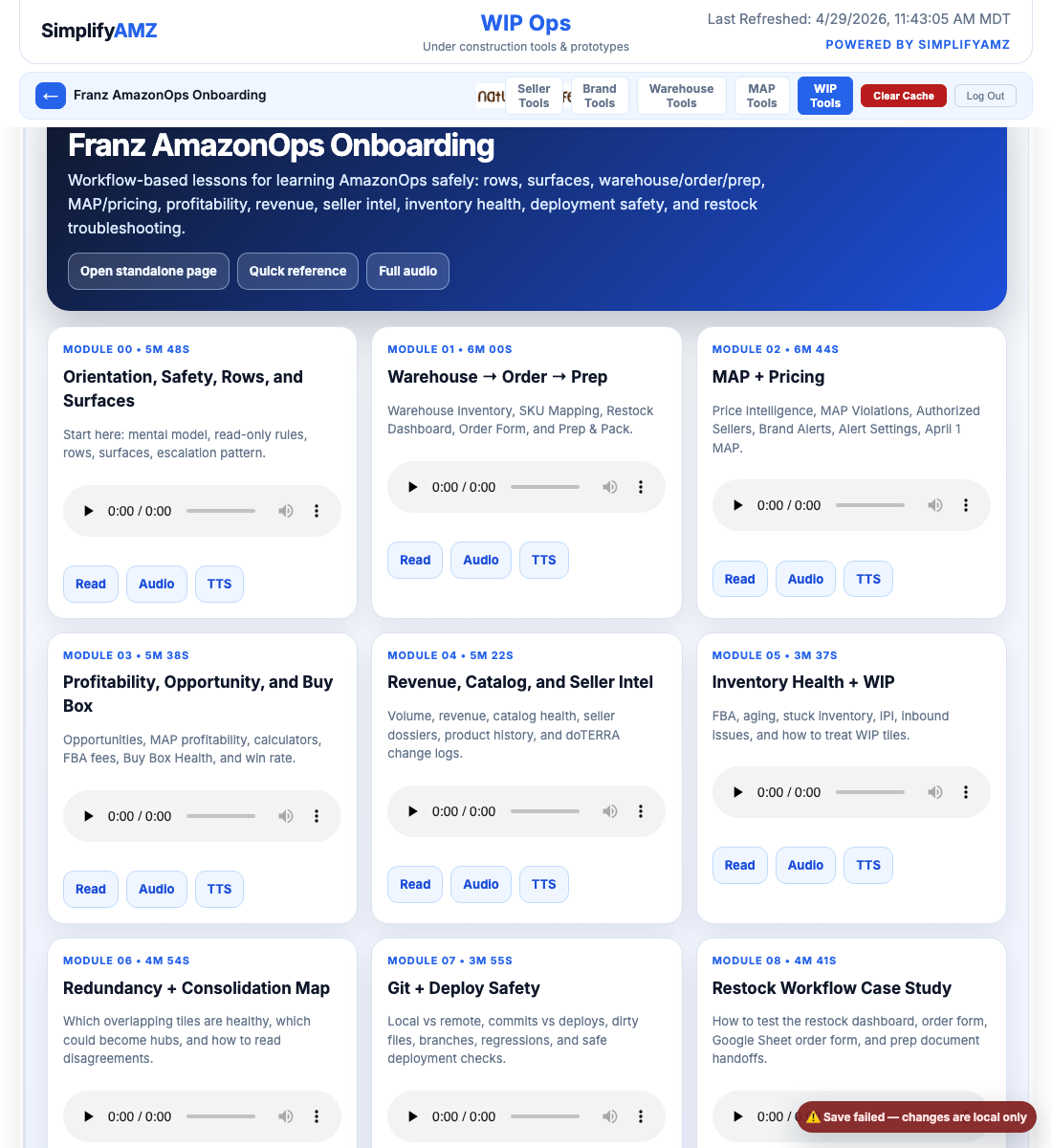
Inventory Health + WIP
This lesson exists because Amazon inventory has many states and WIP tiles are useful but must be treated cautiously.
Business questions this lesson answers
- What does Amazon have?
- What is aging, stuck, reserved, or noncompliant?
- Which WIP tiles are safe to trust?
- When should Franz escalate?
Teaching rule
Franz should explain the purpose, the origin problem, every important part inside the tile group, and the action/escalation rule before moving on.
Pass 2 elaboration overlay
Why this exists
This lesson exists because Amazon inventory has many states and WIP tiles are useful but must be treated cautiously.
How this connects to restock and operations
This tile group either creates the restock decision, validates whether the decision is safe, or explains business context that can override the math. Franz should always connect the tile back to a real decision: monitor, investigate, reorder, block, or escalate.
What to listen for in the Pass 1 audio
The original Pass 1 lesson contains the dense operating details. In this upgraded Pass 2 version, Franz should listen once for orientation, then read the full source lesson below and mark any field or phrase he cannot explain.
Full Pass 1 lesson content — preserved and expanded
Module 05 — Inventory Health, Account Health, and WIP Tiles
This module covers diagnostic inventory/account tiles and provisional WIP tiles. These are important, but they are usually second-layer after the core warehouse/order/prep and MAP workflows.
Inventory Management cluster
Tiles involved: FBA Inventory, Aging Inventory, Stuck Inventory, IPI, and Inbound Noncompliance.
How to separate them:
- FBA Inventory: what Amazon currently has.
- Aging Inventory: what is getting old.
- Stuck Inventory: what is not flowing.
- IPI: account-level inventory performance.
- Inbound Noncompliance: shipment or inbound problems.
Restock Dashboard asks what to order. Warehouse Inventory asks what Brent physically has. Inventory Management asks what Amazon has and whether it is healthy.
1. FBA Inventory
Purpose: monitors Amazon-side sellable, reserved, inbound, and related inventory states.
Escalate when Restock Dashboard says one thing but FBA Inventory suggests another.
Ask Fergus: “Is this sellable FBA stock, reserved stock, inbound stock, unfulfillable stock, or physically warehouse stock?”
2. Aging Inventory
Purpose: identifies inventory that is aging and may create fee or account-health pressure.
Escalate when a product appears as a restock opportunity but also has aged inventory risk.
Ask Fergus: “Are we trying to buy more of something Amazon already considers aging?”
3. Stuck Inventory
Purpose: identifies stock that exists but may not be moving, flowing, or becoming sellable as expected.
Escalate when FBA stock exists but sales/restock logic behaves as if it is unavailable.
Ask Fergus: “Is this stock sellable, reserved, stranded, stuck, or delayed?”
4. IPI Score & Performance
Purpose: account-level inventory performance and manual entry context.
Escalate when inventory decisions may affect account health or IPI pressure.
Ask Fergus: “Is this a SKU-level inventory problem or an account-level inventory health problem?”
5. Inbound Noncompliance
Purpose: highlights Amazon inbound or shipment compliance problems.
Use it when shipment issues, prep problems, or Amazon receiving problems may explain inventory weirdness.
Ask Fergus: “Is this inventory issue caused by inbound noncompliance or receiving delay?”
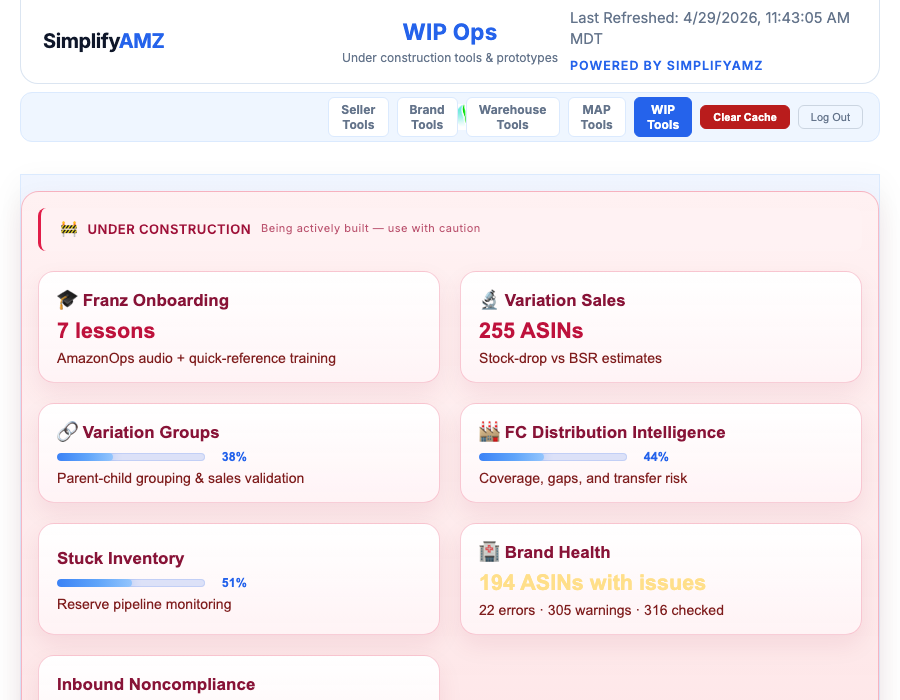
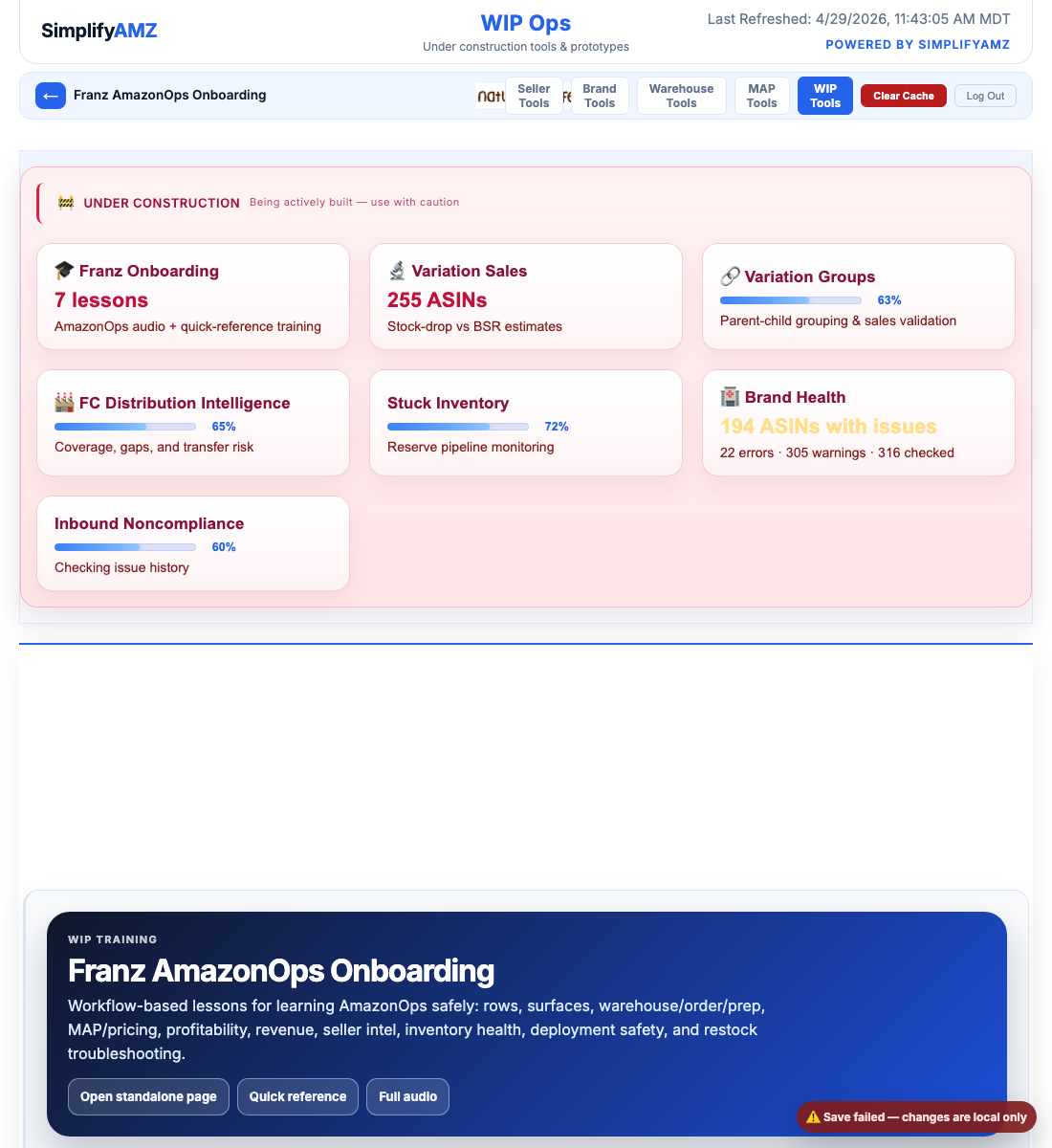
WIP and Under Construction
Treat WIP tiles as provisional. They may contain active experiments, incomplete validation, or staging logic. Do not use WIP output as final evidence without checking timestamps and asking Fergus.
Examples of WIP/provisional areas:
- FC Distribution Intelligence: useful for fulfillment-center coverage and transfer-risk analysis, but timestamp-sensitive.
- Variation Sales and Variation Groups: useful but validation-heavy.
- Advertising Performance: API setup required; live campaign metrics are not connected yet.
- Equipment: shared warehouse equipment/request queue, useful but not core Amazon analysis.
Safe interpretation rule
If a WIP tile disagrees with a production tile, production wins until Fergus says otherwise.
Better escalation:
“I see a WIP tile suggesting X, but the production tile says Y. Is WIP testing a new model, or should I ignore it for now?”
End of module 05.
Original narration transcript
Screenshot references used in this curriculum
franz education tile
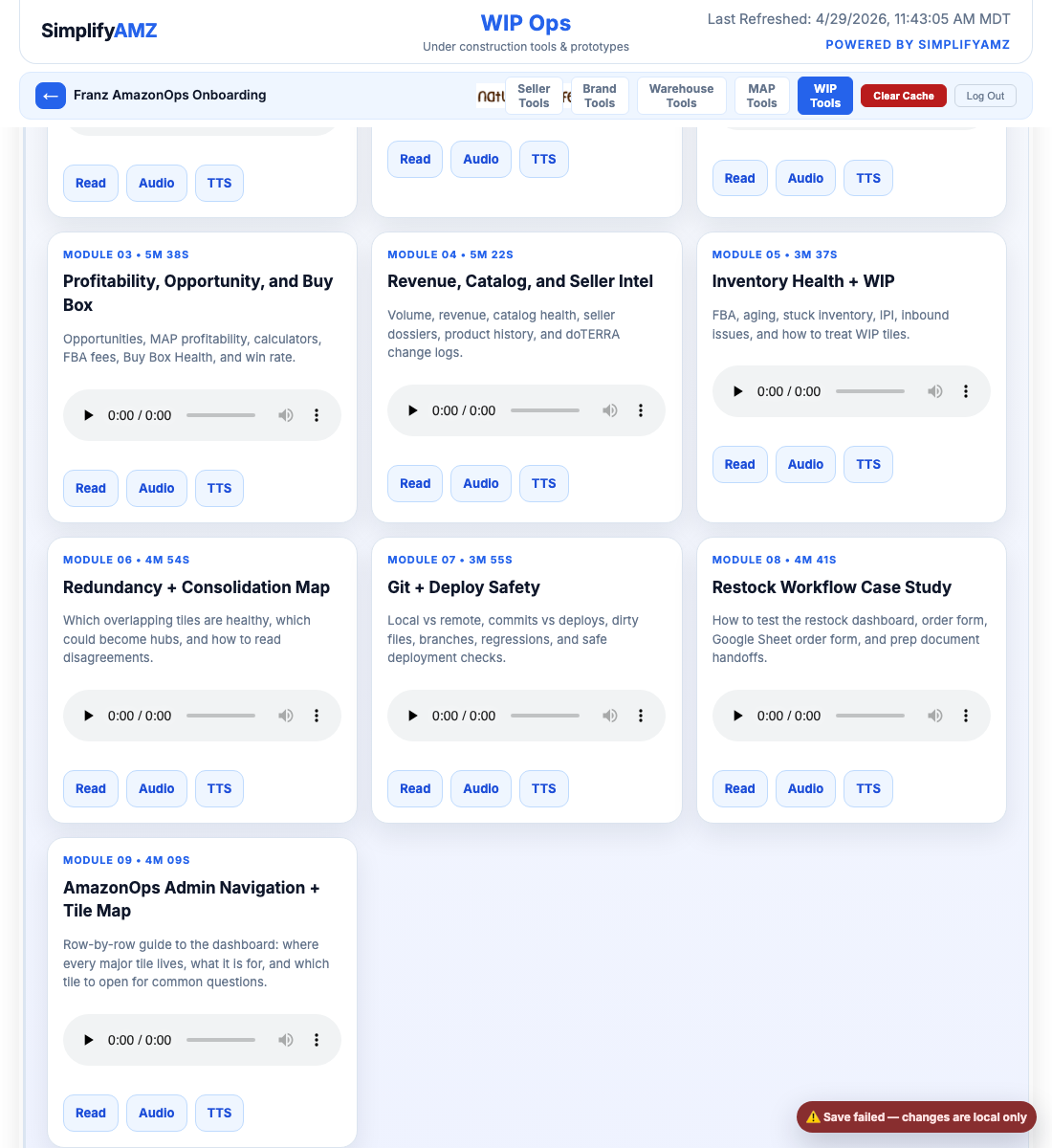
franz module 09 visible
franz onboarding open
franz start here first
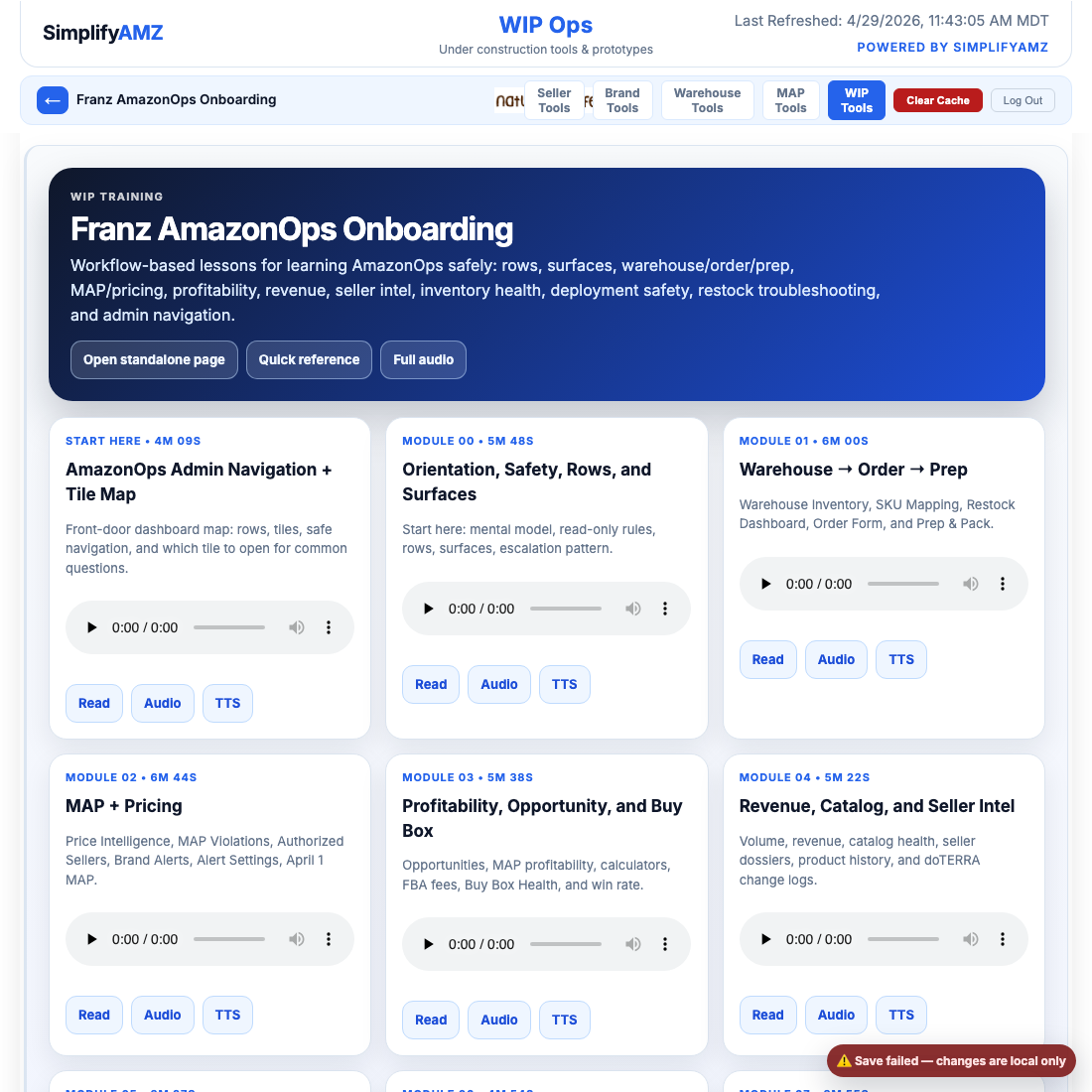
franz training section